[FTL's comments are in
blue.]
...So I guess this is what you might refer to as “the setup” in either Syn2 or Syn4.
Let's go back to the race, again using your pacelines. For setup I'm going to use the most common ground which is 8F, not 8.318 which the race was actually run. The pacelines for #2,#3 and #7 were all run at a mile. That is the most common distance. Ergo, the distance we use for SYN2 is one mile.
For the second call I'm using #4's last race of 111 4/5.
For the final time I'm using #2's last race of 139 1/5.
This is where the matchup comes into play. I'm not using pars. I'm using the contenders' lines only.
For track record I'm using the track record of 134 4/5.
The program automatically makes variant energy adjustments based on the above.
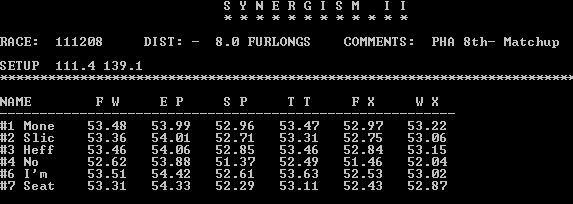
At this point this screen should be self-explanatory:
 As far as “how to use it” goes, I agree that any horse within the 5 points of the top horse was considered a contender, however, it doesn’t always work out that way. Sometimes there is one horse that sits at the top and is more than 5 points higher than the rest of the field.
This is not common, but it does happen. When it does I will not hide or bet against this top horse. I'll either bet him to win and place, or look to see if there's value in the show pool if this is a big stakes race. Betting against these horses is a losing proposition in the long run. Note, this applies to RDSS too.
In that case, the “5 point rule” would be applied to the next highest horse and all the horses that fall in that area were considered contenders along with the top horse.
That's what was recommended in
Pace Makes The Race. However, in my experience these horses are not true win contenders. They are in the race, but I won't back any of them to win.
In addition, there are times when an early horse ranked 1 or 2 does not fall into the parameters noted above in the “5 point rule”.
True.
Because of its’ 1 or 2 ranking, that horse would also be considered a contender.
Here we disagree. I'd say that horse may affect the outcome of the race, but he would not be a win contender.
The same applied to the third fraction horses. If a horse ranked 1 or 2 for third fraction did not fall into the “5 point rule” noted above, it was still considered a contender.
The program would print out all of the various velocity ratings and rankings along with either %early or %med, whichever you chose. It also had a model built in, where you could store information on the winning horse by track distance, surface, age, sex and race type. It was really a very nice program for the time.
Sounds nifty.
Since none of these style programs “point” you towards a projected winner, record keeping naturally played a LARGE part in future decision making when choosing horses to bet.
I strongly agree.
Getting back to the race at hand, I learned from Pino and Jeff that when you don't have a track model you look for horses that are ranked first or second in FW, TT and DR.
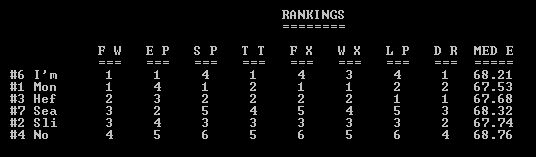
Three horses qualify: #6, #1 and #3.
If you go by the actual TT number it's #6 and #1 as the final contenders (but you're really splitting hairs prefering 53.47 over 53.46).
If I were betting this race with the odds on #6 and #1 both being above 3-1 I'd have made the wager 50%/50%. Here it would have worked out.
Using SYN2 I'd have won this race.
As you can see though there's a lot of handicapping done before the pacelines are entered when using SYN2. However if I had to bet $1000 on a race I'd definitely use SYN2 rather than SYN4 or SYN7 (the other SYN program I have).